


First Edition of Advanced Math Programme for Students Across India Concludes at IIT Guwahati
- Yasaswini Sampathkumar

- Jun 30
- 4 min read
Updated: Jul 6
101 Foundation partnered with The Department of Mathematics at IIT Guwahati to conduct the first edition of PRISM 2026, a six-week residential training programme in mathematics. The programme is built on a simple premise: that the way a professional mathematician thinks can be taught to teenagers.
Published 30 June 2026 | Category Education and Teaching | Office Dept of Mathematics
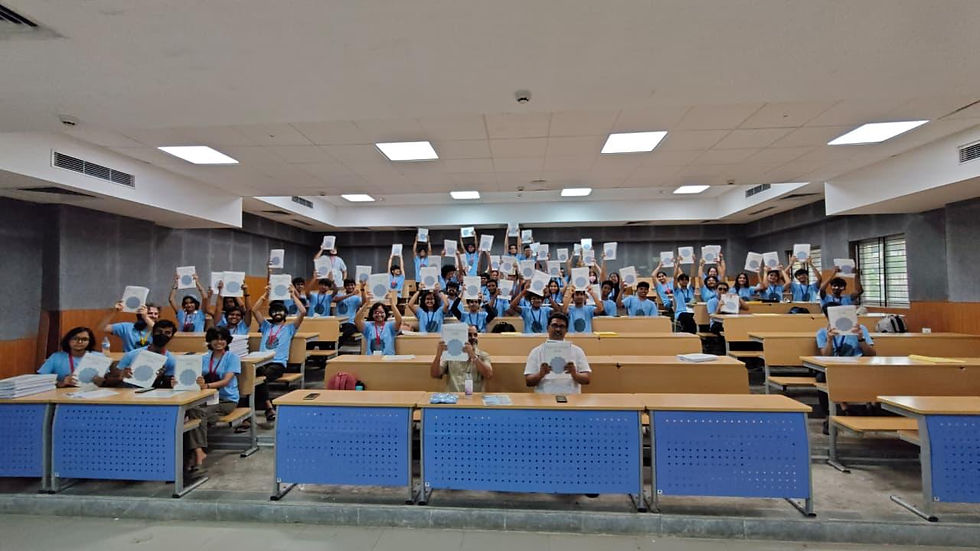
PRISM — the Programme for Research and Inquiry by Students in Mathematics — was designed to introduce school students to the habits of research mathematicians. Not textbook problem-solving. Not competitive exam prep. The kind of open-ended, self-directed inquiry that mathematicians actually use to discover new ideas.
For Programme Director Prof. Ila Varma of the University of Toronto, the results exceeded her own expectations. "I have seen an extremely superior level of mathematics from students this year," she says.
Bringing the Best Together
Varma grew up in the United States, learning Indian school mathematics from textbooks her parents sourced from relatives back home, while also attending American math enrichment camps. The two experiences, she found, did different jobs: Indian curriculum built strong fundamentals; the camps taught students to explore, question, and build the instincts for original inquiry.
PRISM is her attempt to bring both pieces together — deliberately, in India's northeast. Her premise: the inquiry-driven mathematics of Gauss, Euclid, or Ramanujan isn't a rare gift reserved for prodigies. It's the work of people who followed curiosity and stayed with hard problems. Given the right environment, she argues, that kind of thinking is available to school students.
Collaboration Over Competition
That environment is deliberately non-competitive, a sharp break from the Olympiad- and entrance-exam-driven culture that dominates math education in Indian classrooms. PRISM asks students to sit with a problem long enough to feel stuck — and to discover that getting unstuck is usually a shared, social process, not a solitary conquest.
For student Ankit Raj, this reordered something. "The competitive environment that I was used to before PRISM seems sad to me now," he says. "The reason for the sadness is because learning need not be competitive."
The structure reinforces this: PRISM pairs two students with one dedicated counsellor for the full six weeks — close and intense, built to guide without spoon-feeding.
For Pranava Kowsika, the shift was as personal as it was mathematical. Her first three weeks were hard. "The maths was different from what I was used to in school," she says, "but the RAs and my counsellor made me feel comfortable and helped me overcome the feeling of stress and inferiority."
The frustration was real — and so was the grit it took to push through it. What made that grit sustainable, she suggests, was a course structure that prized collaboration and discovery over drilling and rank.
Why the Northeast
The choice of campus wasn't incidental. Varma credits the IIT Guwahati campus itself with shaping how students engaged with the material — and, just as importantly, the location keeps students from the northeast close to home, in a familiar environment, while they take on unfamiliar mathematics.
That's core to the programme's vision: catalysing a culture of early, serious interest in mathematics in the region. And with real local partnership from IIT Guwahati's mathematics faculty, this edition has set that process in motion.
The mandate extends outward, too. The next editions aim to widen the net further — reaching students and communities who rarely get a chance to pursue mathematics beyond the classroom — and to bring international mathematicians to the northeast for the first time, alongside a growing cohort of counsellors whose own mathematical growth will get more attention in future editions.
"This programme reminded me of why I fell in love with math in the first place," says Kanak Sanghvi, a counsellor from ISI Bangalore.
"This is also the first place where I truly felt valued and looked out for. It gave me a real sense of community and belonging," she adds.
Can This Scale?
Underneath the logistics is a bigger argument Varma is making: that advanced mathematical training can be democratised. Reaching research-level mathematics, in her view, doesn't require rare early exposure or a special background — it requires the right attitude, sufficient support, and consistency over time. She points to her own field, number theory, as an illustration: start with the arithmetic children learn in primary school, then ask the question a real researcher would ask — if you were the person who first noticed patterns in numbers, how would you go about finding them?
There's a sharper edge to this in the current moment, to. If artificial intelligence can compute and even conjecture, the ability to ask new questions may be the part of mathematics that stays distinctly human. Read that way, PRISM isn't just IIT Guwahati hosting a summer programme — it's an institution looking at what mathematical training could look like as the field reinvents itself.
Not every PRISM student will become a research mathematician, and Varma is candid that this was never the only measure of success. The habits the programme builds — mathematical tools, sustained curiosity, tenacity in the face of a hard problem — are, in her view, transferable to almost any field a student eventually chooses, whether that's a STEM discipline or something like sociology, journalism, and literature.
As Pranava Kowsika put it, describing what the six weeks left behind: "Nothing is permanent if we have the courage to face the problem."
Comments