


"This Is Really the Time": A Conversation with the Director of NCRA-TIFR
- Yasaswini Sampathkumar

- Jun 9
- 6 min read
Updated: Jun 10
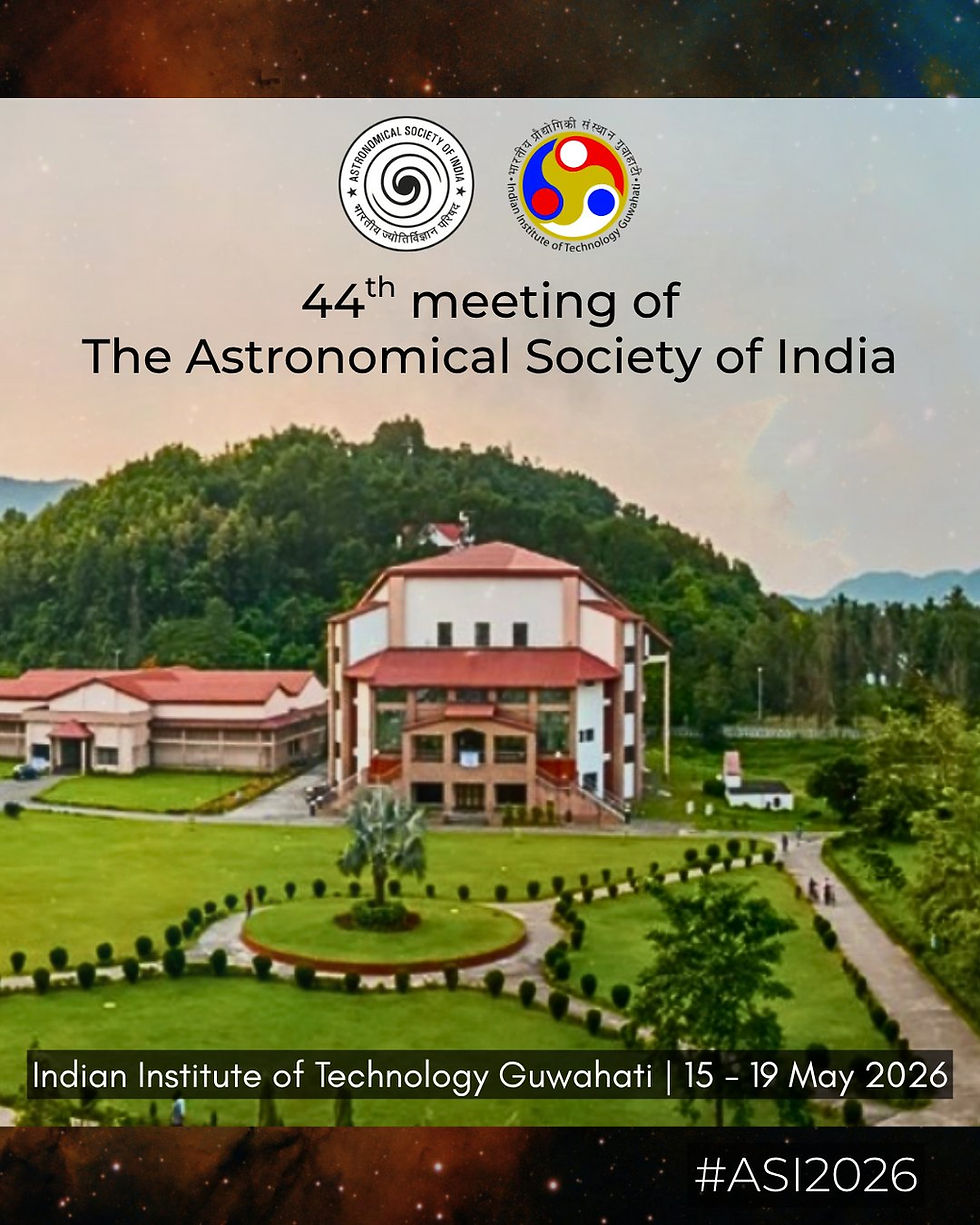
The 44th Annual Meeting of the Astronomical Society of India was held at IIT Guwahati this year — and with it came some of the country's most distinguished astronomers. We sat down with Prof Yashwant Gupta, Director of NCRA-TIFR, to talk about how India built one of the world's great radio astronomy facilities, why this moment is unlike any before it, and what it means for engineering students who want to study the universe.
Published 15 June 2026 | Category Meetings and Conferences | Office Dept of Physics

"There is no reason why a celestial object should emit only in the range our eyes can detect,” says Prof Yashwant Gupta.
Most people think of astronomy as optical — telescopes, lenses, visible light. But light is just a narrow slice of the electromagnetic spectrum, which stretches all the way from gamma rays down to the longest wavelength radio waves.
It took time for people to realise that other kinds of electromagnetic waves could be detected and that looking at those other wavelengths could reveal things that visible light never would.
“The Earth's atmosphere is not equally permeable to all frequencies. The ozone layer blocks ultraviolet rays, and other parts of the atmosphere block large parts of the spectrum. But other than visible light, the most usable window is in the radio part of the spectrum — from around 30 megahertz to 300 gigahertz. And as it happens, India has a significant claim at the very beginning of that story."
Bose Before Marconi
"Acharya J.C. Bose, working in Kolkata, demonstrated for the first time how to generate and receive radio waves. When you ask people who did this, they usually say Marconi," says Prof Gupta.
But J.C. Bose did it more than a year before Marconi did it in Europe.
"Bose demonstrated it and moved on. The world now acknowledges this. IEEE has installed a milestone plaque at the place where Bose worked in Kolkata. But Marconi saw the practical application and built the telecommunications revolution from it."
And as part of that revolution, accidentally, radio astronomy was born.
An engineer at Bell Labs named Karl Jansky was given the task of debugging some telecommunications equipment that was producing unwanted noise. He systematically traced the source and found it wasn't internal to the electronics, and wasn't nearby. "It was coming from a fixed direction in the sky, moving as the Earth rotated. That is how radio astronomy started," says Prof Gupta.
Radio Astronomy in India
It wasn't very long before this fledgling field came to India.
By the 1960s, people were doing experiments in radio astronomy in India. But two groups really drove its development.
One was at TIFR, led by Prof. Govind Swarup. The other group was at the Raman Research Institute, started by Prof. Radhakrishnan.
"The TIFR group built the first telescopes themselves," says Prof Gupta "Starting with an array at Kalyan near Bombay, then the Ooty Radio Telescope, built by 1970 and still running today. After more than 50 years, we are still refurbishing and improving it."
The Big Boy: Giant Meterwave Radio Telescope
The next step in India was the building of the Giant Metrewave Radio Telescope (GMRT) near Pune. It was conceived in the late 1980s, built through the 1990s, and operational from 2001.
"When I was finishing my PhD in 1989, Prof. Swarup's team approached me and said that they were building a brand new, world-class radio observatory and asked if I was interested in coming back? It looked like an interesting possibility. I said yes," says Prof Gupta recalling being recruited when he was at UC San Diego.
What Makes the GMRT Special?
The GMRT is one of the largest and most sensitive radio astronomy facilities working in the low frequency range. It underwent a major overhaul between 2013 and 2019.
Prof Gupta explains the relevance of being able to detect cosmic signals in this range.
"Two things make the radio frequency range scientifically significant. The first is hydrogen."
Hydrogen is the most predominant constituent of the universe. It is present in our galaxy, in distant galaxies, in the earliest galaxies that ever formed. The universe is expanding, and the further away an object is, the faster it is receding from us. When a source moves away, its signal shifts to a lower frequency — the Doppler effect. To detect hydrogen from the very first galaxies, you need to track that signal as it shifts down toward 100 megahertz. The GMRT was designed to do exactly that.
"You are essentially taking a cross-section through the history of the universe," says Prof Gupta.
The second is pulsars — rotating stars made entirely of neutrons, born when a massive star collapses at the end of its life.
They were theoretically predicted in the 1930s but discovered accidentally in the 1960s. "They were initially, somewhat jokingly, called Little Green Men," laughs Prof Gupta, "somebody signalling to us. It turned out they were natural sources, and they emit most strongly in exactly the frequency range the GMRT covers."
What Comes Next and Why No Single Country Can Build It Alone
Building something more capable than the GMRT needs enormous investment. No single country can do that alone.
And the Square Kilometre Array (SKA) is the next big thing.
The SKA is a 13-country collaboration, and the telescopes are being built in two of the most radio-quiet locations on Earth: the Australian outback and the Karoo desert in South Africa.
"I have been to these sites," says Prof Gupta. "From the nearest town, you take an hour-and-a-half flight in a six-seater plane and land on a dirt strip. When we visit, we have to leave our cell phones and laptops in a separate enclosure before we can enter. That is how serious the interference problem is."
India received final government approval three years ago to participate in the SKA construction phase, with an investment of around ₹1,250 crores. By working on the SKA, industry partners in India get the opportunity to manufacture cutting-edge technology — building capacity that leads to downstream benefits.
A Growing Community — and What It Means for Students at IITs
With growing government support and technological advancements, the astronomy community in India is growing.
"I have been coming to the ASI annual meeting for 25 years," says Prof Gupta. "In those early years, you would see 200 people. Now you see 600, 800. And the institutions they come from have changed. Earlier it was almost entirely the specialised research organisations — NCRA, RRI. Now you see people from IITs, IISERs, universities. At this meeting I ran into someone from Purvanchal University in Jaunpur. I said, I didn't know astronomy happens there. He said: I am the first faculty member doing astronomy there. So it is really that time."
For engineering students wondering whether there's a place for them in this expanding world, Prof Gupta speaks from experience — he studied electrical engineering at IIT before finding his way to the stars.
"The peer pressure and environment pushed toward engineering. That is real and I understand it. But the option to transition exists, and it is much more available now than it was in my time."
He is quick to add that the transition needn't mean starting over.
"You don't have to leave your training behind. You bring it with you. The skills you are building in electronics, computing, data analysis, software — they are genuinely useful in astronomy. I have seen people with strong engineering backgrounds do excellent work at GMRT. The avenues exist at IIT Guwahati. IIT Indore and IIT Kanpur now have thriving astronomy groups. It is for the student to look for them."
What Sustains an Institution After the Visionary Is Gone?
Radio astronomy in India was seeded by visionaries like Prof Govind Swarup. However, continuing to be in the forefront of technological advancements requires sustained institutional culture. As India begins many ambitious technological projects, it is important to understand how institutions can build and sustain a culture of excellence.
Prof Gupta has an unusual answer. He says that many research groups in institutions across the country are organised around individual performance - one scientist, their lab, their students.
The NCRA, however, is centred around a common facility. Every faculty member contributes to it.
"You have your own research, your own area of science," explains Prof Gupta, "but it is coupled with a shared engineering and technical team, a shared mission."
The combination of individual scientific ambition working within a collective infrastructure builds a distinctive culture and keeps the fire burning beyond the tenure of the original visionary.
That culture — patient, collective, built for the long run — is what made much of Indian astronomy possible. And it will probably make whatever comes next possible too. For students wondering whether to step in, the institutions are ready.
It is, as he says, really that time.
Prof. Yashwant Gupta was in Guwahati for the 44th Annual Meeting of the Astronomical Society of India.

Comments