


Nanometer Precision in Space: Prof Annapurni Subramniam on Building Space Telescopes
- Yasaswini Sampathkumar

- Jun 9
- 6 min read
Updated: Aug 10
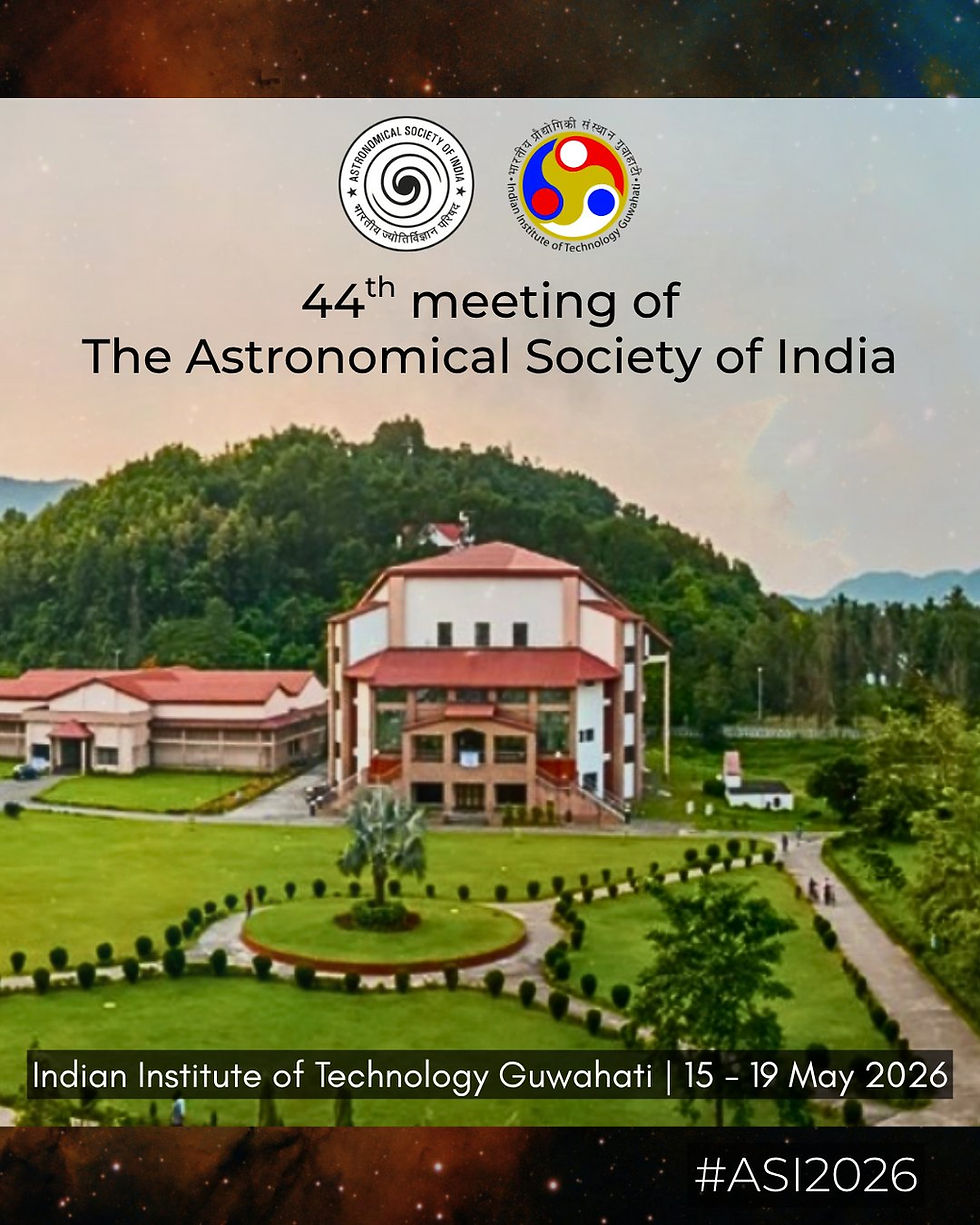
AstroSat was expected to last five years. It is still going 11 years later. On the sidelines of ASI 2026 in IIT Guwahati, Prof Annapurni Subramaniam of the Indian Institute of Astrophysics talks about what it actually takes to engineer something that works — in orbit, where no one can fix it.
Published 15 June 2026 | Category Meetings and Conferences | Office Dept of Physics

Prof. Annapurni Subramaniam is Director of the Indian Institute of Astrophysics in Bengaluru, and the scientist who led the ultraviolet instrumentation on AstroSat — India's first multi-wavelength space observatory.
AstroSat was launched in 2015 and still operating more than a decade later. Prof Annapurni speaks about a mission where you cannot afford to be imprecise. "That's the culture you need for space telescopes," says Prof Annapurni. In space, the difference between a telescope that works and one that doesn't can come down to a single screw — and how far it was turned.
There Is No Going Back
Engineering for astronomy has always requires extreme precision. But a ground-based telescope can be upgraded. Scientists and engineers can tend to the instruments, correct errors, and even compensate for wear.
In orbit, none of that is available. Every decision made in the lab before launch is permanent. An error made at any stage of construction does not stay at that stage — it compounds. A tolerance missed in the mechanical assembly can affect optical performance. A contamination event in the clean room can show up as degraded efficiency 650 kilometres above the Earth.
This is the central fact of space telescope engineering, and it shapes everything else about how AstroSat was built.
A Screw Turned Exactly 60 Degrees
The ultraviolet instruments on AstroSat were among the most technically demanding components of the mission.
"The X-ray instruments had some prior heritage in Indian astronomy, the UV instruments were being built largely from scratch," says Prof Annapurni.
Ultraviolet light is blocked by the Earth's atmosphere, which means UV astronomy can only be done from space — and it also means that every design choice, every material, every process had to be validated without the possibility of in-flight correction.
The precision required was not figurative. A screw tightened 60 degrees means exactly 60 degrees. "Too loose, and components rattle during the violence of launch. Too tight, and they crack under the stress," explains Prof Annapurni.
There is no tolerance for approximation because the physics of the situation leaves no room for it.
And contamination was among the gravest risks. Ultraviolet detectors are acutely sensitive to even microscopic contamination. "The expected efficiency degradation going into the mission was as high as 60 to 70 percent," says Prof Annapurni.
However, the team built a dedicated clean room facility at IIA, implemented strict protocols at every stage, controlled environments, and precise handling procedures. And held the actual degradation to a maximum of 15 percent. AstroSat's ultraviolet instruments launched at 85 to 88 percent of their designed efficiency. In space telescope terms, that is extraordinary.
125 Years of Learning and Teaching Precision
That level of precision does not emerge from a single project or a single generation of engineers. It is the product of an institution that has spent 125 years developing, refining, and transmitting the habits that make precision possible at scale.
"The IIA is one institute in the country that is unique which is operating the Kodaikanal Observatory for more than 125 years," says Prof Annapurni.
It was not just the instruments that were built here, but the culture around operating them. The knowledge was passed on when the Kavalur observatory was established in the 1960s. Kavalur personnel, in turn, trained the teams at Hanle in Ladakh, which has been operating in some of the harshest conditions on Earth for 25 years. High altitude, extreme cold, remoteness — Hanle demands some of the same rigour that space demands. When something goes wrong at Hanle, help is not close. You have to have done it right the first time, or know exactly how to fix it with what you have.
So each generation at IIA inherited not just equipment but accumulated knowledge — about what fails, why it fails, and what processes prevent failure from propagating. People who have seen things go wrong teaching people who haven't yet, so that the lessons are carried forward in the hands as much as in the mind.
The Culture That Holds It Together
The other thing transmitted across generations at IIA, notes Prof Annapurni, is a particular way of responding when things do go wrong. In a project as complex as AstroSat — eleven years from formal approval to launch, involving multiple institutions, disciplines, and thousands of individual decisions — things will go wrong. The question is what happens next.
The answer, at IIA, is not a blame culture. It is a problem-solving culture. When something fails, the focus is on understanding what happened, mitigating the consequences, and building a process that prevents recurrence.
Open communication is part of this — the optical team questioning the mechanical team's calculations, scientists checking engineers' assumptions, no one too senior to be questioned and no question too basic to be asked. The goal is shared, and the goal is the outcome: a telescope that works, in orbit, where no one can reach it.
Prof Annapurni says that this orientation toward the mission rather than toward individual performance allows the institution to sustain excellence across time. Mistakes are accepted as part of complex work. What is not accepted is repeating them.
A Decade in Orbit — and Still Going
AstroSat launched in September 2015. Its minimum lifespan was five years. It is still operating.
The extended life is the direct result of the habits, culture and diligence applied before launch. Components built with low tolerance for error, strictly controlled contamination, systems designed with inevitable ageing in mind. Today, aging batteries are being carefully managed and conserved through precise maneuvering. The parallels with the Hubble Space Telescope, which has now operated for more than 30 years against an original design life of 15, are not accidental. The principles are the same: build it right, manage it carefully, and it will outlast your expectations.
What AstroSat Made Possible
The mission's longevity matters because of what AstroSat has done — and continues to do — for Indian astronomy.
Its ultraviolet instruments filled a gap that ground-based observatories, by definition, cannot fill: UV light is invisible from the Earth's surface. Combined with the X-ray, optical, and infrared data available from other sources, AstroSat made genuine multi-wavelength astronomy possible for Indian researchers. It became possible to observe the same object simultaneously across different parts of the electromagnetic spectrum, and to build a complete picture that no single wavelength can provide alone.
But perhaps AstroSat's most consequential contribution has been to who gets to do astronomy.
Historically, data from major observations was closely held by the teams that proposed them.
AstroSat data was made publicly accessible after a proprietary period, with IIA building a pipeline to deliver science-ready, pre-processed data that researchers could use without needing specialist calibration expertise.
The result, combined with better internet access, affordable computing, and accessible software tools, was an expansion of the Indian astronomy community — students and researchers at universities far from the traditional centres of the field, producing work with space telescope data that would previously have been inaccessible to them.
What Comes Next
The precision culture and engineering capability developed through AstroSat is now being directed toward the next generation of challenges. The proposed 30-metre telescope requires segmented mirrors — because no single mirror blank of that size can be manufactured — with tolerances measured in nanometres and processes designed so that errors at one stage cannot propagate to the next. It is, in a sense, the same problem AstroSat posed, at a larger scale and with higher stakes.
AstroSat is, in that sense, not just a telescope. It was a part of a continuing story of Indian institutions engineering things to work in the most unforgiving environment that exists and opening up the country to studying the universe.
Prof. Annapurni Subramaniam is Director of the Indian Institute of Astrophysics, Bengaluru, and was the Principal Investigator for AstroSat's ultraviolet instruments. She delivered the public lecture at ASI 2026, Guwahati, titled "A Decade of AstroSat — India's First Space Observatory."

Comments