IIT Guwahati Hosts Batch 13 of Ashtalakshmi Darshan Youth Exchange Programme
- Yasaswini Sampathkumar

- Apr 7
- 4 min read
Fourteen days of cultural immersion, collaborative research, and cross-regional friendship send forty-four delegates home as ambassadors of the Northeast.
Published 29 March 2026 | Category Community & Outreach | Office Student Affairs

When student delegates from Chhattisgarh and New Delhi arrived at IIT Guwahati on 17 March 2026, they stepped into a region many of them had encountered only in textbooks. By the time they departed on 28 March, they had stood beside the Brahmaputra, debated the geopolitics of a border region, listened to indigenous music, and even composed a poem for the people who had become their friends. That transformation is precisely what the Ashtalakshmi Darshan Youth Exchange Programme is designed to produce.
Now in its thirteenth batch, the programme is organised under the aegis of the Ministry of Development of North Eastern Region (DoNER) and the North Eastern Council (NEC), with IIT Guwahati serving as host institution. Its name carries a deliberate resonance: just as Ashtalakshmi represents the eight forms of divine prosperity in Indian tradition, the eight northeastern states each contribute a distinct form of cultural and ecological wealth to the region's extraordinary mosaic.
A Lamp Lit in the Spirit of Enlightenment
The inaugural session on 17 March opened with the ceremonial lighting of the lamp and the invocation of the Vedic mantra Tamaso Ma Jyotirgamaya — lead me from darkness unto light — setting the tone for a fortnight of inquiry. Each dignitary on the dais was felicitated with a traditional Assamese Gamusa.
Nodal Officer Dr. Rajkumar P. Thummer told participants that what lay ahead was not a conventional educational visit but an opportunity to experience the living traditions, landscapes, and communities of the region at first hand. The carefully curated fourteen-day itinerary was designed to create lasting impressions and meaningful connections.
Prof. Devendra Jalihal, Director of IIT Guwahati and chief guest at the inauguration, invited the students to look at their surroundings with curiosity. Describing the institute's campus beside the mighty Brahmaputra and tracing the region's history from the Ahom kingdom to its mosaic of tribal cultures, he reminded delegates that the Northeast is the land where the first rays of the sun greet the nation.
Ten Research Themes, One Deeper Purpose
Central to the programme is an academic component that sets it apart from a purely experiential exchange. Students were organised into collaborative groups and asked to conduct original research across ten themes: Transport and Connectivity, Traditional Ecological Knowledge of Tribal Communities, Biodiversity Hotspots, Music and Contemporary Art, Migration Patterns, Handlooms and Handicrafts Beyond Silk, Insurgency and Peacebuilding, Women's Empowerment, Food Culture and Indigenous Cuisines, and the Geopolitics of North-East India.
The breadth of these themes was itself a statement. The Northeast is not a single, uniform story but a layered terrain that rewards serious attention. Projects were evaluated on originality, depth of research, presentation quality, and the quality of collaboration.
The First Prize for Best Group Project went to the team researching Insurgency and Peacebuilding in North-East India; the Second Prize to the group on Traditional Ecological Knowledge of Tribal Communities; and the Third Prize to the team examining Women's Empowerment in North-East India. Among individual presenters, Ms. Aneesa Bakker received the First Prize, Ms. Shruthi Sahu the Second, and Ms. Aishwarya the Third.
A Valedictory Session That Felt Like a Farewell
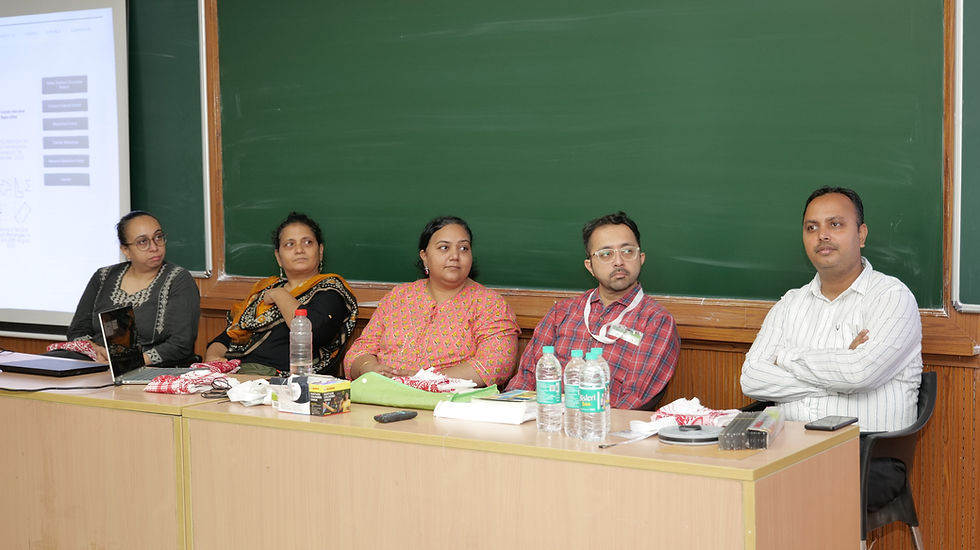
The closing ceremony on 27 March had a deeply personal touch. Presided over by Prof. Sukumar Nandi, Dean of Administration, and attended by Prof. Anupam Saikia and Prof. Perumal Alagarsamy, Deans of Outreach Education and Students' Affairs respectively, the session moved between institutional address and genuine emotion.

Prof. Saikia reminded the delegates that their immersion in the Northeast now made them its ambassadors. Sharing what they had learned about the culture, diversity, and opportunities of the region with their home communities was itself a form of national service.
Prof. Alagarsamy encouraged participants to document their reflections and submit them to the programme coordinators, so that a collective publication might one day capture the perspectives of all who had passed through the Ashtalakshmi Darshan journey.
Prof. Nandi, in a historically grounded address, drew on landmarks such as Poa Mecca to illustrate the layered cultural and spiritual heritage of the region, and offered a counsel well suited to the digital age: verify what you read, think critically, and take an active role in preserving India's diverse traditions.
A memorable moment of the afternoon came from Mr. Rakesh Kumar of Chhattisgarh who rose to recite a poem he had composed for his fellow participants and the faculty coordinators who had accompanied them — an expression of gratitude and camaraderie that no certificate can convey.
Bridges Built, Story to Be Continued
Participation certificates were presented to all delegates and faculty coordinators; volunteers and administrative staff were felicitated with Assamese Gamusa and mementos. A group photograph marked the formal close of proceedings. A farewell dinner in the Mini Auditorium foyer gave participants one final meal together before dispersal.
The Ashtalakshmi Darshan Programme operates within the framework of the Government of India's Ek Bharat Shreshtha Bharat initiative, which holds that the unity of a diverse nation must be actively cultivated, not assumed. Batch 13 has done its part. The delegates who arrived as visitors to the Northeast left as something closer to its storytellers — carrying, in the words of Prof. Saikia, the responsibility to build awareness of a region that has long deserved a more central place in the national imagination.

Comments