


AI-Powered Metallurgy: IIT Guwahati and UK Partners Design Sustainable Alloys Without Scarce Raw Materials
- Yasaswini Sampathkumar

- Feb 17
- 2 min read
Updated: Apr 8
Published: 3 February 2026 Category: Research & Partnerships Office: Department of Mechanical Engineering
Modern high-tech industries—from aerospace to nuclear power—rely on "High-Entropy Alloys" (HEAs) for their extreme strength and heat resistance. However, these materials often depend on Critical Raw Materials (CRMs) like tantalum and tungsten, which are difficult to mine, environmentally taxing, and subject to volatile global supply chains.
To solve this, researchers from IIT Guwahati, London South Bank University, the University of Manchester, and the University of Leeds have created a first-of-its-kind computational framework that designs superior alloys using only abundant, sustainable elements.
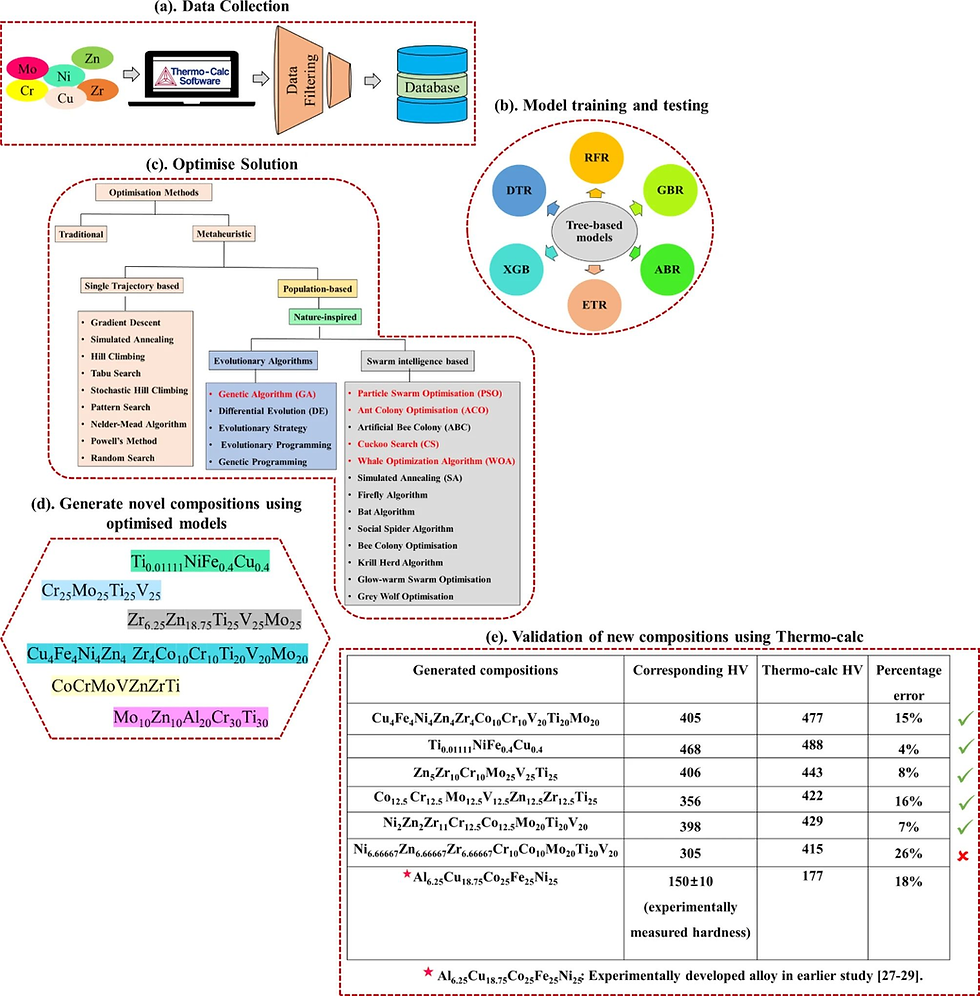
How Machine Learning Improves Traditional Design
Traditional alloy design is a slow process of trial and error. The team, led by Prof. Shrikrishna N. Joshi, used an "Extra Trees Regressor" model to scan a database of over 3,600 alloy compositions.
The AI identified a specific CRM-free combination—Ti–Ni–Fe–Cu—that was predicted to outperform well-known industry alloys in hardness. Laboratory tests at IIT Kanpur later confirmed the AI’s accuracy, proving that high-performance materials do not have to be "critically scarce" to be effective.
A Generalizable Blueprint for Industry
What makes this framework unique is its portability. It does not rely on complex microstructural data; it works entirely on compositional information. This makes it a "plug-and-play" solution for designing materials with various properties, including:
Extreme Hardness: For wear-resistant mechanical parts and industrial tooling.
Corrosion Resistance: For maritime and chemical processing equipment.
Thermal Stability: For automotive and engine components.
"This is the first validated framework for designing CRM-free alloys using only basic compositional data," says Prof. Joshi. "It is highly transferable to other material systems, even where experimental data is limited."
Having proven the concept in the lab, the international research team—which includes members from the University of Leeds and the University of Manchester—is now seeking industry partners to test these sustainable alloys under real-world operating conditions.
Read the paper here: https://doi.org/10.1038/s41598-025-87784-0
Comments